





















Health News Articles
Below are key excerpts of revealing news articles on health from reliable news media sources. If any link fails to function, a paywall blocks full access, or the article is no longer available, try these digital tools.
For further exploration, delve into our comprehensive Health and Food Corruption Information Center.

As a women's health advocate and practicing OB-GYN for 25 years, I want to point out that some doctors, especially male gynecologists, pediatricians and anesthesiologists and psychiatrists, have raped, fondled and molested patients of all ages. Finally, the conversation is getting started because of Dr. Lawrence G. Nassar. He's the former team doctor for U.S.A. Gymnastics, and he was sentenced to 60 years in prison on child pornography (37,000 images!) charges. I've heard story upon story about sexual misconduct from my patients, including inappropriate touching and sexual misconduct during their gynecologic exams when they were young women. Experiences like these have a long-term negative effect on a woman and the way she takes care of her physical health during her lifetime. Trying to get any hard facts or statistics about doctor sexual misconduct is very difficult. According to the Atlanta-Journal Constitution, "half of the more than 2,400 doctors sanctioned since 1999 for sexual misconduct involving patients still have active medical licenses." A nationwide investigation by the AJC published in July 2016 found widespread sexual abuse by doctors from OB-GYNs committing rape and anesthesiologists taking advantage of sedated patients to pediatricians molesting children. We cannot tolerate business as usual. I would like to see a law passed where violating a patient would result in revoking his or her medical license, jail time and being forever identified as a sex offender on state registries.
Note: For more along these lines, see concise summaries of deeply revealing news articles on sexual abuse scandals and health.
How much more proof do we need that being online isnt healthy for us? The latest terrible tech research is from Kaiser Permanente. In a study of hundreds of pregnant women in the Bay Area, the authors found that those who were more exposed to the kind of radiation produced by cell phones, wireless networks and power lines were nearly three times as likely to suffer miscarriages. These electromagnetic fields, or EMFs, are around every single one of us. There will be tremendous pushback against any research showing how dangerous this stuff may be. An example: San Franciscos radiation-warning law, championed by then-Mayor Gavin Newsom, passed in 2010. But after a lawsuit from the cell phone industry, the city backed off on implementing it. Around the same time, the California Department of Public Health drew up its set of guidelines to inform the public about the risks associated with cell phone use. The health department then sat on these guidelines for seven years. The health departments lawyers ... argued that releasing the guidelines might cause the public to panic. Well, it might be time to start panicking. More and more, it sounds like the long-term effects of our Internet habits could be dangerous, not just for our relationships and our ability to focus, but our brains and bodies as well. The small-but-growing body of EMF research looks like anti-tobacco research must have looked in the 1950s necessary and important work that will surely gain researchers an ugly, uphill battle against better-funded opponents.
Note: Read an excellent article on the serious dangers of 5G wireless technology which is being rolled out. For more along these lines, see concise summaries of deeply revealing health news articles from reliable major media sources.
Pregnant women exposed to high radiation levels from sources like cell phones, wireless devices and cell towers miscarried at nearly three times the rate as those exposed to low levels, according to new research. I hope this study makes us rethink the notion that magnetic field non-ionizing radiation exposure is safe or has no health risk, said lead author Dr. De-Kun Li. Cell phones, cordless phones and other wireless devices, appliances, power lines, smart-meter networks and cell towers generate non-ionizing radiation from magnetic fields. Writing in Scientific Reports, Li and his team call rapidly proliferating electromagnetic field emissions a ubiquitous environmental exposure and a serious looming public health challenge. For the study, more than 900 pregnant women in the San Francisco area carried meters that measured their exposure to electromagnetic field radiation. Expectant mothers with the highest exposure levels during their typical weekday routines were 2.7 times as likely to miscarry as women with the lowest levels. The results underscore the need for additional research into possible health harms of a technology to which virtually everyone in the U.S. is now exposed, whether by choice or circumstance, Li said. A federal study last year found an increased risk of cancer associated with magnetic field non-ionizing radiation exposure in rodents. Li called the findings from the National Toxicology Program stunningly important.
Note: The National Toxicology Program study mentioned above came to light in 2016 after scientists posted some of its preliminary findings to a public website. For more along these lines, see concise summaries of deeply revealing news articles on the risks of cell phones and wireless devices.
A reputable-sounding nonprofit organization released a report attacking the organic food industry in April 2014. The 30-page report by Academics Review, described as a non-profit led by independent academic experts in agriculture and food sciences, found that consumers were being duped into spending more money for organic food. The [group's] press release ends on this note: Academics Review has no conflicts-of-interest associated with this publication, and all associated costs for which were paid for using our general funds without any specific donor influence or direction. What was not mentioned in the report, the news release or on the website: Executives for Monsanto Co., the worlds leading purveyor of agrichemicals and genetically engineered seeds, along with key Monsanto allies, engaged in fund raising for Academics Review, collaborated on strategy and even discussed plans to hide industry funding, according to emails obtained by U.S. Right to Know. Jay Byrne, former head of communications at Monsanto ... offered to act as a commercial vehicle to help find corporate funding for Academics Review. In March 2016, Monica Eng reported ... on documents showing that Monsanto paid Professor Bruce Chassy more than $57,000 over a 23-month period to travel, write and speak about GMOs - money that was not disclosed to the public. The money was part of at least $5.1 million in undisclosed money Monsanto sent through the University of Illinois Foundation.
Note: Monsanto has reportedly pushed fake science in other circumstances as well. Major lawsuits are beginning to unfold over Monsanto's lies to regulators and the public on the dangers of its products, most notably Roundup. Yet the EPA continues to use industry studies to declare Roundup safe while ignoring independent scientists. For more along these lines, see concise summaries of deeply revealing news articles on food system corruption and health.
Regulators have approved the first drug with a sensor that alerts doctors when the medication has been taken. The digital pill combines two existing products: the former blockbuster psychiatric medication Abilify - long used to treat schizophrenia and bipolar disorder - with a sensor tracking system first approved in 2012. Experts say the technology could be a useful tool, but it will also change how doctors relate to their patients as theyre able to see whether they are following instructions. The pill has not yet been shown to actually improve patients medication compliance, a feature insurers are likely to insist on before paying for the pill. Additionally, patients must be willing to allow their doctors and caregivers to access the digital information. The technology carries risks for patient privacy, too, if there are breaches of medical data or unauthorized use as a surveillance tool, said James Giordano, a professor of neurology at Georgetown University Medical Center. Could this type of device be used for real-time surveillance? The answer is of course it could, said Giordano. The new pill, Abilify MyCite, is embedded with a digital sensor that is activated by stomach fluids, sending a signal to a patch worn by the patient and notifying a digital smartphone app that the medication has been taken.
Note: In 2010, it was quietly reported that Novartis AG would be seeking regulatory approval for such "chip-in-a-pill technology". For more along these lines, see concise summaries of deeply revealing news articles on microchip implants and the disappearance of privacy.
A nascent movement of activists working to reframe psilocybin as both a medicine and as a tool for personal or spiritual growth [thinks] researchers and policy makers should be able to discuss, in a dispassionate way, the medical or recreational use of hallucinogenic drugs a subject that not long ago was unthinkable. The Boston Entheogenic Network (BEN) ... formed last year. Instead of the more familiar, more polarizing adjective psychedelic, BEN uses the term entheogenic - meaning generating the divine within - to describe multiple methods of achieving altered states of consciousness. Proof of medical usefulness was the first step toward marijuanas legalization. Could it be the same for hallucinogens? In fact, medical applications for psilocybin abound. Recent studies have found that MDMA seems to be a remarkably useful tool in treating post-traumatic stress disorder, when combined with psychotherapy. In August, the FDA designated the drug as a breakthrough therapy, meaning that it may have substantial advantages over existing PTSD treatments. Other studies suggest psilocybin has promise as a treatment for anxiety and depression. Meanwhile, microdosing - the regular use of tiny amounts of LSD or other psychedelics not to hallucinate but to improve creativity and mood - has become a Silicon Valley trend. Advocates for psychedelics have come a long way from Learys indiscriminate call for young people to turn on, tune in, and drop out, but many still believe these drugs could change the world.
Note: Read more about how MDMA has been found effective for treating PTSD in a therapeutic context. Articles like this suggest that the healing potentials of mind-altering drugs are gaining mainstream scientific credibility.
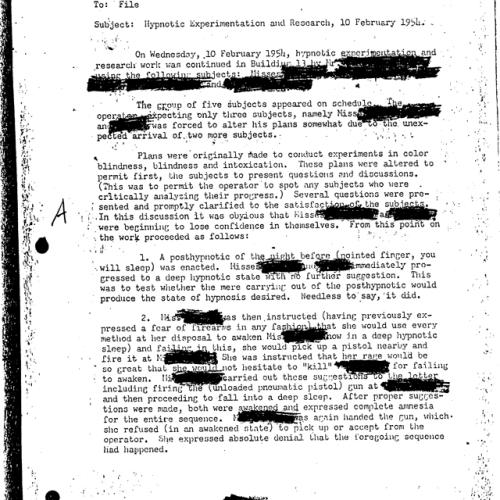
Members of Congress are demanding answers after a St. Louis scholar's new book revealed details of secret Cold War-era U.S. government testing in which countless unsuspecting people, including many children, pregnant women and minorities, were fed, sprayed or injected with radiation and other dangerous materials. Lisa Martino-Taylor ... wrote "Behind the Fog: How the U.S. Cold War Radiological Weapons Program Exposed Innocent Americans," [using] Freedom of Information Act requests to obtain previously unreleased documents, including Army records. She found that a small group of researchers, aided by leading academic institutions, worked to develop radiological weapons and later "combination weapons" using radioactive materials along with chemical or biological weapons. Martino-Taylor said the offensive radiological weapons program was a top priority for the government. Unknowing people in places throughout the U.S., as well as parts of England and Canada, were subjected to potentially deadly material through open-air spraying, ingestion and injection. "They targeted the most vulnerable in society," Martino-Taylor said. "They targeted children. They targeted pregnant women. People who were ill in hospitals. They targeted wards of the state. And they targeted minority populations." [House Democrat William Lacy] Clay said he was angered that Americans were used as "guinea pigs" for research. "I join with my colleagues to demand the whole truth about this testing," Clay said in a statement.
Note: See this news article for photos and a video of this event. Read about dozens of other incidents in which humans were used as guinea pigs, at times resulting in deaths that were covered up. Another video is available here. For more along these lines, see concise summaries of deeply revealing news articles on corruption in government and in the scientific community.
For a quarter of a century, the concept of false memories has provided a scientific fig leaf for sceptics of child sexual abuse allegations. The false memory argument is deceptively simple: children and adults are prone to invent false memories of child sexual abuse that never occurred, particularly if encouraged by a therapist. So-called recovered memories, in which adults recall sexual abuse in childhood after a period of amnesia, have been a particular focus of disbelief. In fact ... studies find that children are far less suggestible than we have been led to believe. Brain imaging studies have identified the neurological mechanisms involved in the process of forgetting and then recalling sexual abuse as an adult. However, for those uncomfortable with the social and legal reforms required to address child sexual abuse, the idea that large numbers of allegations are the product of false memories remains attractive. This argument underpins recent reporting in the Australian, which has called into question the findings of the royal commission into institutional responses to child sexual abuse, on the basis that sexual abuse survivor testimony cannot be trusted. Allegations of sexual abuse are always a challenge to authority. In response, many are driven to reject the allegations outright, rather than examine the uncomfortable truths they reveal. Attacks on the credibility of abuse survivors and advocates, and on the findings of the royal commission ... are not justified by research on sexual abuse and traumatic memory; far from it.
Note: Watch an excellent segment by Australia's "60-Minutes" team "Spies, Lords and Predators" on a pedophile ring in the UK which leads directly to the highest levels of government. A second suppressed documentary, "Conspiracy of Silence," goes even deeper into this topic in the US. For more, see concise summaries of sexual abuse scandal news articles.
Increased levels of prenatal fluoride exposure may be associated with lower cognitive function in children, a new study says. The study, published ... in the journal Environmental Health Perspectives, evaluated nearly 300 sets of mothers and children in Mexico and tested the children twice for cognitive development over the course of 12 years. The study found a drop in scores on intelligence tests for every 0.5 milligram-per-liter increase in fluoride exposure beyond 0.8 milligrams per liter found in urine. Although the researchers found a potential connection to a child's exposure to fluoride in utero, they found no significant influence from fluoride exposure on brain development once a child was born. "Childhood exposure to fluoride is safer than prenatal. The fetal system tends to be more sensitive to environmental toxicants than once the child is born," said the study's lead author, Howard Hu, founding dean of the Dalla Lana School of Public Health at the University of Toronto. Fluoride is commonly added to drinking water in the United States in order to improve dental health, though a number of communities including Portland, Oregon, and Tucson, Arizona, have rejected water fluoridation. What the new research means for pregnant women in the United States is up in the air. Previous studies have found fluoride to be a potential neurotoxin at extremely high levels.
Note: This Newsweek article and this MSNBC article also raise serious questions about the benefits and risks of fluoride in our water. For more along these lines, see concise summaries of deeply revealing health news articles from reliable major media sources.
Adding fluoride to public drinking water for dental purposes has been controversial since the practice first began in 1945. A new study suggests that prenatal exposure to this chemical may affect cognitive abilities and that children born to mothers exposed to high amounts of fluoride could have lower IQs. The study ... found an association between lower intelligence and prenatal fluoride exposure in 299 mother-child pairs in Mexico. Even when other possible factors were taken into account, such as exposure to other chemicals, results continually showed that higher prenatal fluoride exposure was linked to lower scores on tests of cognitive function in children at age 4 and then again between 6 and 12. The mothers in this study did not have fluoride added to their water. In Mexico, fluoridated salt is the main way that women get salt into their diet, says Hu, unlike in the U.S., where fluoridated water is the main avenue. The data could renew the debate about the safety of adding fluoride to tap water, in part because experts have not been quick to dismiss the findings. "This is a very well-conducted study, and it raises serious concerns about fluoride supplementation in water," says Dr. Leonardo Trasande, a pediatrician who studies potential links between environmental exposures and health problems at New York University. Trasande ... also explains that fluoride is known to disrupt thyroid function, which in turn is crucial for brain development.
Note: Another Newsweek article and this MSNBC article also raise serious questions about the benefits and risks of fluoride in our water. For more along these lines, see concise summaries of deeply revealing health news articles from reliable major media sources.
For Jon Lubecky, the scars on his wrists are a reminder of the years he spent in mental purgatory. He returned from an Army deployment in Iraq a broken man. He got every treatment offered by Veterans Affairs for post-traumatic stress disorder. But they didnt stop him from trying to kill himself - five times. Finally, he signed up for an experimental therapy and was given a little green capsule. The anguish stopped. Inside that pill was the compound MDMA, better known ... as ecstasy. That street drug is emerging as the most promising tool in years for the militarys escalating PTSD epidemic. The MDMA program was created by a small group of psychedelic researchers who had toiled for years in the face of ridicule, funding shortages and skepticism. But the results have been so positive that this month the Food and Drug Administration deemed it a breakthrough therapy - setting it on a fast track for review and potential approval. Only two drugs are approved for treating PTSD: Zoloft and Paxil. Both have proved largely ineffective. By giving doses of MDMA at the beginning of three, eight-hour therapy sessions, researchers say they have helped chronic PTSD patients process and move past their traumas. In clinical trials with 107 patients closely monitored by the FDA, 61 percent reported major reductions in symptoms - to the point where they no longer fit the criteria for PTSD. Follow-up studies a year later found 67 percent no longer had PTSD.
Note: Read more about how MDMA has been found effective for treating PTSD in a therapeutic context. Articles like this suggest that the healing potentials of mind-altering drugs are gaining mainstream scientific credibility.
Baby Boomers are sucking the blood of the young. They are ... after the plasma. In Monterey, California, a new startup has emerged, offering transfusions of human plasma: 1.5 litres a time, pumped in across two days, harvested uniquely from young adults. Ambrosia, the vampiric startup concerned, is run by a 32-year-old doctor called Jesse Karmazin, who bills $8,000 (6,200) a pop for participation in what he has dubbed a study. So far, he has 600 clients, with a median age of 60. The blood is collected from local blood banks, then separated and combined it takes multiple donors to make one package. The idea has become faddish in tech circles. Mike Judges Silicon Valley sitcom recently parodied the notion, with arch-tech guru Gavin Belson relying on a blood boy following him around to donate pints of sticky red at inopportune moments. That fictionalised account may well be based on the real-life adventures of Peter Thiel, the PayPal founder. A 2014 Harvard report ... seems to have kickstarted the present revival of interest in transfusions. There, scientists injecting old mice with the plasma of a younger generation found it improved their memory and their ability to learn. Conversely, injecting old blood into young seemed to knobble the young rodents. The scientific community has rolled its eyes at the trial element of Ambrosia. There is no control group and, with participation costing so much, no one involved is very randomised.
Note: Read more about Silicon Valley billionaire Peter Thiel's investment in this questionable technology. One university researcher has found that many in the European royalty until the end of the 18th century practiced selective cannibalism in the belief if would keep them young. Another article goes into greater depth about the practice some elder members of the wealthy elite taking blood infusions from young people to stay young.
Scientists in the U.S. and India have found an inexpensive treatment that could possibly save hundreds of thousands of newborns each year. And it turns out, the secret weapon was sitting in Asian kitchens all along: probiotic bacteria that are common in kimchi, pickles and other fermented vegetables. Feeding babies the microbes dramatically reduces the risk newborns will develop sepsis, scientists report ... in the journal Nature. Sepsis is a top killer of newborns worldwide. Each year more than 600,000 babies die of the blood infections. "All the sudden the baby stops being active. It stops crying and breastfeeding," says Dr. Pinaki Panigrahi, a pediatrician ... who led the study. For the past 20 years, Panigrahi has been working on a way to prevent sepsis. The tricky part, Panigrahi says, was figuring out the best strain of bacteria to protect against sepsis. "We screened more than 280 strains," Panigrahi says. "So it was a very methodical process." In the end, the one that seemed the most promising was a strain of lactobacillus plantarum. So Panigrahi and his team decided to move forward with a large-scale study. They were shocked by how well the bacteria worked. Babies who ate the microbes for a week ... had a dramatic reduction in their risk of death and sepsis. They dropped by 40 percent, from 9 percent to 5.4 percent. But that's not all. The probiotic also warded off several other types of infections, including those in the lungs. Respiratory infections dropped by about 30 percent. A course of the probiotic costs about $1 per baby.
Note: Explore a treasure trove of concise summaries of incredibly inspiring news articles which will inspire you to make a difference.
Contaminants detected in water samples throughout the country pose health risks but are perfectly legal. Most people turn on their tap water and think: Its clear, I live in America, we have these laws, Im being protected, said Nneka Leiba, director of the Healthy Living Science Program for the Environmental Working Group (EWG). In 1974, Congress enacted the Safe Drinking Water Act, authorizing the Environmental Protection Agency (EPA) to set national standards for drinking water. However, it has been more than 20 years since the EPA has added a new contaminant to its list of regulated drinking water pollutants. The list of regulated chemicals has not kept up with our use of chemicals as a country, Leiba said. EWG collected data from drinking water tests ... at more than 48,000 water facilities throughout the U.S., looking for 500 unique contaminants. The group found 267 present in water supplies, many at levels above what scientific studies have found pose health risks but are still legal under the Safe Drinking Water Act. EWG's findings: 93 of the contaminants were linked to an increased risk of cancer; 78 were associated with brain and nervous system damage; 63 were connected to developmental harm in children or fetuses; 38 were contaminants that could cause fertility issues; and 45 were endocrine disruptors. More than 40,000 water systems had levels of known or likely carcinogens that exceeded health guidelines.
Note: EWG has made its data available in the form of a public database. Due to systematic distortion of water quality tests by US authorities, up to 98 million Americans may have unsafe levels of lead in their drinking water. For more along these lines, see concise summaries of deeply revealing health news articles from reliable major media sources.
The Food and Drug Administration (FDA) is often accused of serving industry at the expense of consumers. This week, [there are reports] of an institutionalized FDA spying program on its own scientists, lawmakers, reporters and academics that included an enemies list of "actors" and collaborators. "Devicegate" dates back at least to January 2009 when scientists ... wrote President Obama that top FDA managers "committed the most outrageous misconduct by ordering, coercing and intimidating FDA physicians and scientists to recommend approval, and then retaliating when the physicians and scientists refused to go along." Unsafe [medical] devices - including those that emit excessive radiation - were approved. For reporting the safety risks, the scientists became targets. Some lost their jobs. The ... reprisals against FDA device reviewers [did not surprise former FDA drug reviewer Ronald Kavanagh]. "After FDA management learned I had gone to Congress about certain issues, I found my office had been entered and my computer physically tampered with," [said Kavanagh]. "Then, after I openly reported irregularities in an antipsychotic drug review and FDA financial collusion with outsiders to ... the House Committee on Oversight and Government Reform, I was threatened with prison. The threats, however, can be much worse than prison. One manager threatened my children - who had just turned 4 and 7 years old - and ... I was afraid that I could be killed for talking to Congress and criminal investigators."
Note: Read more on how the FDA spied on whistle-blowing scientists to suppress safety concerns. For more along these lines, see concise summaries of deeply revealing news articles on corruption in government and in the scientific community.
The American Medical Association will no longer tolerate sexual misconduct by physicians at least if their victims are other doctors, and if the abuse occurs at an AMA event. But the association is doing nothing to crack down on predators who violate other victims: their patients. Almost a year after The Atlanta Journal-Constitution revealed widespread sexual misconduct in the medical profession, the AMA has scheduled neither formal proposals nor public discussions on doctors who abuse their patients. The organizations silence forfeits an opportunity to address a problem that has stirred public interest. They seem more likely to address someone elses problems than their own, said Lisa McGiffert, manager of the Safe Patient Project. The newspaper identified more than 2,400 doctors who had been disciplined for sexual violations involving patients; half are still licensed to practice medicine. But the numbers fail to capture the scope of misconduct. Many state medical boards deal with sex cases in private and issue no public findings. Others use vague language or euphemisms to hide the true nature of disciplinary matters. By some estimates, 7 percent of American doctors have engaged in sexual misconduct meaning that tens of thousands may have engaged in harassment, molestation, even rape. The AMA plays no direct role in licensing or disciplining doctors, a function of state medical authorities. But the association is a powerful voice for the medical profession.
Note: For more along these lines, see concise summaries of deeply revealing news articles on sexual abuse scandals and health.
People who drink diet sodas daily have three times the risk of stroke and dementia compared to people who rarely drink them, researchers reported Thursday. It's yet another piece of evidence that diet drinks are not a healthy alternative to sugary drinks, and suggests that people need to limit both, doctors said. The researchers, led by Matthew Pase ... and colleagues, studied more than 4,000 people for their report, published in the journal Stroke. "We found that those people who were consuming diet soda on a daily basis were three times as likely to develop both stroke and dementia within the next 10 years as compared to those who did not consume diet soda," Pase told NBC News. "Our study provides further evidence to link consumption of artificially sweetened beverages with the risk of stroke," the team wrote. "To our knowledge, our study is the first to report an association between daily intake of artificially sweetened soft drink and an increased risk of both all-cause dementia and dementia because of Alzheimer's disease." The team did not find the same risk for sugar-sweetened beverages. But they found other troubling signs. "Those who more frequently consume sugary beverages such as fruit juices and sodas had greater evidence of accelerated brain aging such as overall smaller brain volumes, they had poorer memory function and they also had smaller hippocampus, which is an area of the brain important for memory consolidation," Pase said.
Note: Previous research has linked diet soda with abdominal fat gain, as well as found a variety of serious health risks to be associated with the popular artificial sweetener aspartame. For more along these lines, see concise summaries of deeply revealing health news articles from reliable major media sources.
Gulping down an artificially sweetened beverage not only may be associated with health risks for your body, but also possibly your brain, a new study suggests. Artificially sweetened drinks, such as diet sodas, were tied to a higher risk of stroke and dementia in the study, which was published in the American Heart Association's journal Stroke. The researchers analyzed how many sugary beverages and artificially sweetened soft drinks each person in the two different age groups drank, at different time points, between 1991 and 2001. Then, they compared that with how many people suffered stroke or dementia over the next 10 years. Compared to never drinking artificially sweetened soft drinks, those who drank one a day were almost three times as likely to have an ischemic stroke, caused by blocked blood vessels, the researchers found. They also found that those who drank one a day were nearly three times as likely to be diagnosed with dementia. Separate previous studies have shown an association between the intake of sugar-sweetened beverages and adverse health effects, such as type 2 diabetes, obesity, heart disease, stroke, and possibly even heart failure.
Note: Explore lots more about the risks and dangers of aspartame in this excellent article. For more along these lines, see concise summaries of deeply revealing news articles on food system corruption and health.
A study in the journal Stroke showed a correlation between drinking diet soda and both stroke and dementia: people who drank at least one diet soda a day were three times as likely to have a stroke or develop dementia as those who avoided the beverages. Previous research had already uncovered a possible link with higher stroke risk. The findings in this study add some support to those results. The link with dementia, however, is new, and at minimum is enough cause for concern that it's worth studying further. Why might diet sodas contribute to these risks? Diet sodas are designed to trick the brain into thinking its getting an extra dose of glucose (the brains fuel), but eventually the trick is on us because the brain adapts to not receiving the added glucose by overcompensating in other ways (leading to a variety of effects still under investigation). Diet sodas could imbalance the bacterial jungle in our guts - the microbiome - causing unpredictable results. Since theres a bacterial superhighway from gut to brain, which we know interacts with key neurotransmitters, this theory may eventually tell us more of a much bigger brain story. This study didnt narrow down the exact types of artificial sweeteners that were consumed, so its an open question how one may have affected the brain differently than another. In the meantime, curtailing how much of any artificial sweetener you ingest, along with added sugar, is a reasonable position to take.
Note: Artificial sweeteners have also been connected with blood sugar level spikes, obesity, and diabetes. There is undeniable evidence that aspartame is toxic to the human body. For more along these lines, see concise summaries of deeply revealing news articles on food industry corruption and health.
Increasing inequality means wealthy Americans can now expect to live up to 15 years longer than their poor counterparts, reports in the British medical journal the Lancet have found. Researchers said these disparities appear to be worsened by the American health system itself, which relies on for-profit insurance companies, and is the most expensive in the world. Their conclusion? Treat healthcare as a human right. The Lancet studies looked at how the American health system affects inequality and structural racism, and how mass incarceration and the Affordable Care Act (ACA), also known as Obamacare, have changed public health. Among the studies key findings: the richest 1% live up to 15 years longer than the poorest 1%; the same gap in life expectancy widened in recent decades, making poverty a powerful indicator for death; more than one-third of low-income Americans avoid medical care because of costs; the poorest fifth of Americans pay twice as much for healthcare as a share of income; and life expectancy would have grown 51.1% more from 1983 to 2005 had mass incarceration not accelerated in the mid-1980s. The poorest Americans have suffered in particular, with life expectancies falling in some groups even while medicine has advanced. All of these health outcomes arrive in the context of widening general inequality. The share of total income going to the top 1% of earners has more than doubled since 1970.
Note: For more along these lines, see concise summaries of deeply revealing news articles on income inequality and health.
Important Note: Explore our full index to revealing excerpts of key major media news articles on several dozen engaging topics. And don't miss amazing excerpts from 20 of the most revealing news articles ever published.