
















Mental Health News Stories
Below are key excerpts of revealing news articles on mental health topics that don't often make mainstream news. If any link fails to function, a paywall blocks full access, or the article is no longer available, try these digital tools.
For further exploration, delve into our comprehensive Health and Food Corruption Information Center.

The single biggest predictor of how happy you are at any given moment isn’t your income, your relationship status, your health, your career, or the city you live in. It’s whether your mind is focused on what you’re doing right now or wandering somewhere else. That’s the whole finding. Present equals happy. Absent equals unhappy. Everything else is details. In 2010, Harvard psychologists Matthew Killingsworth and Daniel Gilbert published a paper in the journal Science with a title that sounds like a Buddhist proverb: “A Wandering Mind Is an Unhappy Mind.” They developed an iPhone app that pinged 2,250 people at random intervals throughout the day, asking three questions: What are you doing? What are you thinking about? How happy are you? People’s minds wandered from what they were doing 46.9 percent of the time. And when their minds wandered, they were consistently less happy than when they were focused on whatever was in front of them. This held true regardless of the activity. What you’re thinking about matters more than twice as much as what you’re doing. You could have the perfect life — the career, the partner, the health, the house — and spend most of it mentally somewhere else, and the somewhere else would make you miserable. We don’t struggle with presence during peak experiences. Nobody’s mind wanders during their wedding or the birth of their child or the moment they land the job they wanted. Those moments are vivid enough to command attention. They handle presence for you. The problem is that peak experiences make up maybe two percent of your life. The other ninety-eight percent ... is ordinary, and your capacity to be present during ordinary moments determines the quality of your entire existence. That’s where happiness actually lives. In the ninety-eight percent. In the ability to be present in an ordinary moment without wishing it were something else.
Note: Explore more positive stories like this in our comprehensive inspiring news articles archive focused on solutions and bridging divides.
People’s connection to nature has declined by more than 60% since 1800, almost exactly mirroring the disappearance of nature words such as river, moss and blossom from books, according to a study. The study by Miles Richardson, a professor of nature connectedness at the University of Derby, accurately tracks the loss of nature from people’s lives over 220 years by using data on urbanisation, the loss of wildlife in neighbourhoods and, crucially, parents no longer passing on engagement with nature to their children. In the research published in the journal Earth, Richardson also identified the disappearance of natural words from books between 1800 and 2020, which peaked at a 60.6% decline in 1990. The modelling predicts an ongoing “extinction of experience” with future generations continuing to lose an awareness of nature because it is not present. Increasing the availability of biodiverse green spaces in a city by 30% may look like radical positive progress for wildlife and people but Richardson said his study suggested a city may need to be 10 times greener to reverse declines in nature connection. Measures to increase popular engagement with the natural world were not effective at reversing long-term declines in nature connectedness. More effective, according to the study, are measures instilling awareness and engagement with nature in young children and families, such as forest school nurseries.
Note: For more along these lines, read our concise summaries of news articles on mental health and environmental destruction.
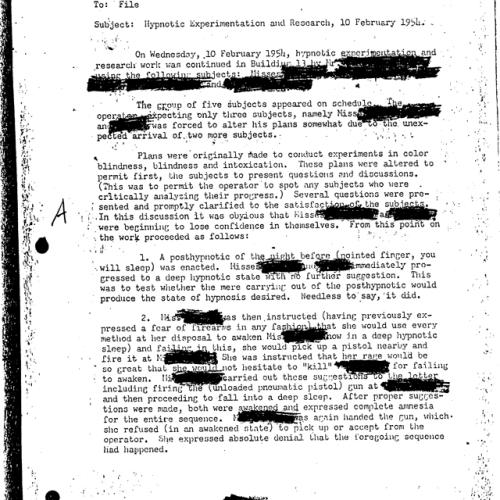
A newly released CIA document reveals a chilling blueprint to manipulate minds through covert drugging experiments. The report, added to the CIA's reading room in 2025, details the government's once top-secret Project Artichoke that ran from 1951 to 1956, focusing on behavior control, interrogation techniques and psychological manipulation. The seven-page document, titled 'Special Research for Artichoke,' with an attachment labeled 'Suggested Fields for Special Research Relative Artichoke,' outlines proposals to develop chemicals capable of altering human behavior. It discusses drugs designed for both immediate effects, like truth serums and long-term influence, potentially administered through food, water, alcohol or cigarettes. Researchers also suggested that such substances could be disguised in medical treatments such as vaccinations or injections. The CIA was also looking into methods beyond chemicals, listing hypnosis, sensory deprivation, gases and other psychological methods for interrogation and behavioral control. Artichoke served as a precursor to the CIA's MKUltra program, which later broadened mind-altering experiments on a larger scale. The researchers involved in the secret program emphasized that long-term compounds should be capable of producing 'an agitating effect (producing anxiety, nervousness, tension, etc.) or a depressing effect (creating a feeling of despondency, hopelessness, lethargy, etc.).'
Note: Learn more about the CIA's MKUltra Program and the mind control techniques perfected by Nazi scientists through disturbing WWII experiments in concentration camps. For more, read our concise summaries of news articles on intelligence agency corruption and mind control.
Children who spend more time on mobile phones, TVs, and video games may face a higher risk of developing attention problems as they grow, according to a first-of-its kind, large-scale study. The findings, recently published in Translational Psychiatry ... indicate a link between longer screen time and more severe symptoms of attention-deficit/hyperactivity disorder (ADHD). Researchers ... also found measurable, though subtle, brain abnormalities among heavy screen users. Longer screen time at ages 9–10 predicted higher ADHD symptoms two years later. Higher screen time was linked to a smaller cortex, the outer layer of the brain responsible for higher-level thinking and attention. Children with more screen time at the outset had a smaller right putamen, a region involved in language learning, addiction, and reward processing. Heavier screen use after two years was tied to slightly thinner development in three other cortical regions that support important cognitive functions, such as attention, working memory, and language processing. Screen use has increased worldwide among children and adolescents, with more than one-third of U.S. parents of a child under 12 reporting their children began interacting with a smartphone before the age of 5. While digital devices are promoted as essential tools for school and social connection, their excessive use has been tied to disrupted sleep, reduced physical activity and negative impacts on mental health.
Note: For more along these lines, read our concise summaries of news articles on Big Tech and mental health.
Marie began taking fluoxetine, the generic form of Prozac, when she was 15. The drug — an S.S.R.I., a selective serotonin reuptake inhibitor — was part of her treatment in an outpatient program for an eating disorder. It took its toll on her sexuality. Marie told me she has PSSD, post-S.S.R.I. sexual dysfunction, a loss of sexuality that persists after the drug is no longer being taken. Clinicians have published more than 500 case reports in academic literature about the experience of PSSD. A 2020 editorial in The British Medical Journal argued, “Post-S.S.R.I. sexual dysfunction is underrecognized and can be debilitating both psychologically and physically.” The effects of S.S.R.I.s on young sexuality are all the more relevant because prescriptions for the drugs have soared. Around two million 12-to-17-year-olds in the United States are on S.S.R.I.s. One large 2024 study ... tallied, month by month, the percentage of that age group who filled an antidepressant prescription between 2016 and 2022. During that time, the rate climbed by 69 percent. There are no dedicated studies of sexual side effects among the young. All that is available is extrapolation from research among adults. Depending on the symptom, drug and duration of use, between 30 and 80 percent of adults taking S.S.R.I.s live to varying degrees with diminished desire, sensation and function, according to a 2019 study.
Note: For more along these lines, read our concise summaries of news articles on Big Pharma profiteering and mental health.
In 2001, the Journal of the American Academy of Child & Adolescent Psychiatry (JAACAP) published a paper declaring that the antidepressant paroxetine (Paxil) was “generally well tolerated and effective” for adolescent depression. That conclusion was false. The manufacturer, GlaxoSmithKline (GSK), knew from its own data that the drug failed to outperform placebo and carried a serious risk of suicidal behaviour. Instead of telling the truth, GSK hired a public-relations firm to ghostwrite the paper, enlisted academic co-authors who never saw the raw data, and used the publication to promote Paxil to doctors treating children. It became known as Study 329 — one of the most infamous cases of scientific fraud in modern psychiatry. The paper remained in circulation — cited hundreds of times, shaping prescribing habits, and legitimising a lie that cost young lives. The paper listed 22 authors — two were GSK employees, and most had never reviewed the raw data or disclosed their financial ties to the company. Once the article appeared in print, GSK’s sales force distributed it to thousands of doctors as “proof” that Paxil worked in teens. Within three years, the company made more than a billion dollars from what it called the “adolescent market.” In 2003, the FDA concluded: “There is currently no evidence that Paxil is effective in children and adolescents with major depressive disorder.” In 2012, GSK pleaded guilty and paid a $3 billion settlement to resolve criminal and civil charges.
Note: For more along these lines, read our concise summaries of news articles on Big Pharma profiteering and mental health.
While Defense Secretary Pete Hegseth obsesses over the supposed “softening” and “weakening” of American troops, the Pentagon is concealing the scale of a real threat to the lives of his military’s active-duty members: a suicide crisis killing hundreds of members of the U.S. Air Force. Data The Intercept obtained via the Freedom of Information Act shows that of the 2,278 active-duty Air Force deaths between 2010 and 2023, 926 — about 41 percent — were suicides, overdoses, or preventable deaths from high-risk behavior in a decade when combat deaths were minimal. This is the first published detailed breakdown of Air Force suicide data. In 2022, the National Defense Authorization Act mandated the Defense Department to report suicides by year, career field, and duty status, but neither the department nor the Air Force complied. Congress has done little to enforce thorough reporting. From 2010 to 2023, active-duty maintainers had a suicide rate of 27.4 per 100,000 personnel, nearly twice the 14.2 per 100,000 among U.S. civilians — a 1.93 times higher risk. FOIA records show the most common methods were self-inflicted gunshot wounds to the head and hanging. Other methods included sodium nitrite ingestion, helium inhalation, and carbon monoxide poisoning. [The dataset] shows a troubling pattern of preventable deaths that leaders at the senior officer level or above minimized or ignored, often claiming that releasing detailed suicide information would pose a risk to national security. Current and former service members described a fear of bullying, hazing, and professional retaliation for seeking mental health treatment.
Note: Read about the tragic traumas and suicides connected to military drone operators. A recent Pentagon study concluded that US soldiers are nine times more likely to die by suicide than they are in combat. For more along these lines, read our concise summaries of news articles on mental health and military corruption.
“Dance is a language of the body,” says Julia F. Christensen, a neuroscientist at the Max Planck Institute for Empirical Aesthetics and author of Dancing is the Best Medicine. “Our brain understands gestures that we may do as we dance like an expressive language.” For centuries, communities have turned to dance not only for celebration but for ritual and healing. Long before scientists tracked brain waves or measured neurotransmitters, dancers had an intuitive understanding of the power of moving together. Now, the research is starting to catch up. A 2024 meta-analysis published in The BMJ reviewed 218 clinical trials and found that dance reduced symptoms of depression more than walking, yoga, strength training, and even standard antidepressants. While only 15 of the studies focused specifically on dance, the results were enough to grab the attention of researchers. Our brains are wired for rhythm—and dancing engages our entire nervous system. Some neuroscientists describe this full-body stimulation as a neurochemical symphony. Anticipating a melody can trigger the release of dopamine. Physical movement boosts endorphins. Dancing with others increases oxytocin. Studies have shown that this trifecta can enhance mood, increase social bonding, and reduce stress. Dance offers a unique way to reconnect with oneself. It can activate emotional, cognitive, and sensory pathways, reawakening a sense of connection within and beyond the self.
Note: Explore more positive stories like this on the power of art and healing our bodies.
Oregon has for years struggled with a drug crisis, reporting one of the highest rates of substance use disorders in the US and ranking last in the nation for access to treatment. The problem is systemic, rooted in decades of failure to invest in the level of behavioral health services needed for people with mental illnesses and addiction. The Pacific north-west state’s significant affordable housing shortage has compounded the challenges, as people languish on the streets without care. On 12 November 2024, Cameron Washam, 45, was lying on the street by Portland’s Union Station, on the brink of death. He and his wife, Christina Bell, 47, had long struggled with homelessness and addiction. Workers from a Portland street outreach initiative coordinated by the Mental Health and Addiction Association of Oregon (MHAAO), a non-profit dedicated to peer recovery services, approached and offered help, saying they could immediately take them to a detox program. They entered detox, Washam got emergency surgery for his infection, and after eight days, they were placed in an outpatient program, then a sober recovery home. The outreach effort [is] called the Provider-Police Joint Connection Program. Since its launch, the program has connected 1,005 people to services, including 651 who received access to programs on the same day outreach teams met them and 159 who got into detox and treatment.
Note: Explore more positive stories on healing our bodies and repairing criminal justice.
Meta whistleblower Sarah Wynn-Williams, the former director of Global Public Policy for Facebook and author of the recently released tell-all book “Careless People,” told U.S. senators ... that Meta actively targeted teens with advertisements based on their emotional state. In response to a question from Sen. Marsha Blackburn (R-TN), Wynn-Williams admitted that Meta (which was then known as Facebook) had targeted 13- to 17-year-olds with ads when they were feeling down or depressed. “It could identify when they were feeling worthless or helpless or like a failure, and [Meta] would take that information and share it with advertisers,” Wynn-Williams told the senators on the subcommittee for crime and terrorism. “Advertisers understand that when people don’t feel good about themselves, it’s often a good time to pitch a product — people are more likely to buy something.” She said the company was letting advertisers know when the teens were depressed so they could be served an ad at the best time. As an example, she suggested that if a teen girl deleted a selfie, advertisers might see that as a good time to sell her a beauty product as she may not be feeling great about her appearance. They also targeted teens with ads for weight loss when young girls had concerns around body confidence. If Meta was willing to target teens based on their emotional states, it stands to reason they’d do the same to adults. One document displayed during the hearing showed an example of just that.
Note: Facebook hid its own internal research for years showing that Instagram worsened body image issues, revealing that 13% of British teenage girls reported more frequent suicidal thoughts after using the app. For more along these lines, read our concise summaries of news articles on Big Tech and mental health.
Over the typical lifetime, happiness tends to follow a U-shaped curve, peaking at 30, plummeting at age 50, before spiking again after 70. It’s a pattern replicated using data going back as far as the 1970s in almost 150 countries. But around 2011, researchers noticed an astonishing reversal in this trend. “This empirical regularity has been replaced by a monotonic decrease in illbeing by age,” they reported in an NBER working paper. In plain English, younger people today are unhappier, both compared to previous generations and to their older peers. In the US, for example, reported rates of anxiety among young people have exploded. So too have emergency room visits for self-harm. Similar trends can be seen in places like other English-speaking countries and the Nordics. “Why did it happen all over the world?” [New York University's Jonathan] Haidt asked before sharing the theory he also puts forward in his best-selling book: “We have over-protected children in the real world and under-protected them online.” Today, rather than playing with their friends, kids stay at home on their devices. Instead of hearing chatter and laughter in the corridor of schools, we hear the gentle tapping of screens. In the UK, as part of the Smartphone Free Childhood grassroots movement, 85,000 parents have signed a pact committing to delay giving their child a smartphone. To date, parents in 25 countries, from Argentina to Uzbekistan, have joined the movement.
Note: A 2017 study found that prison inmates spend more time outside than kids. For more along these lines, read our concise summaries of news articles on Big Tech and mental health.
Loneliness not only affects how we feel in the moment but can leave lasting imprints on our personality, physiology, and even the way our brains process the social world. A large study of older adults [found] that persistent loneliness predicted declines in extraversion, agreeableness, and conscientiousness—traits associated with sociability, kindness, and self-discipline. At the same time, higher levels of neuroticism predicted greater loneliness in the future, suggesting a self-reinforcing cycle. Although social media promises connection, a large-scale study published in Personality and Social Psychology Bulletin suggests that it may actually fuel feelings of loneliness over time. Researchers found that both passive (scrolling) and active (posting and commenting) forms of social media use predicted increases in loneliness. Surprisingly, even active engagement—often believed to foster interaction—was associated with growing disconnection. Even more concerning was the feedback loop uncovered in the data: loneliness also predicted increased social media use over time, suggesting that people may turn to these platforms for relief, only to find themselves feeling even more isolated. Lonely individuals also showed greater activation in areas tied to negative emotions, such as the insula and amygdala. This pattern suggests that lonely people may be more sensitive to social threat or negativity, which could contribute to feeling misunderstood or excluded.
Note: For more along these lines, read our concise summaries of news articles on mental health and Big Tech.
For the past 12 years, I have tried to share moments beyond the dramatized images of battlefield action, emotional homecomings and veterans in crisis. I’ve photographed the often-overlooked everyday moments that make up this military life. The constant moves and goodbyes. Objects that make up this life that don’t exist in civilian domestic spaces. The days after a deployment, when a service member “re-integrates” back into the family and into civilian society. John didn’t start going to therapy until after he had turned in his retirement papers. He was concerned that it might jeopardize his career. I am on my computer when John leaves a notebook on my desk. He doesn’t say anything. It is the journaling he has been doing with his therapist — her new strategy to get him to open up. He starts the journal with how many US soldiers and Afghan security forces were killed in each operation and what awards were given: Silver Stars, Bronze Stars with valor, Purple Hearts. I know the casualties are what weighs most heavily on him, but he is proud of the awards given to his soldiers. Then he goes into detail about a traumatic event he experienced in Afghanistan. As I read his vivid recollections of violence — which included body parts, trails of blood and the smell of burnt flesh — tears ran down my face. I am only beginning to understand what he has been through. John’s career spanned the entirety of the 20-year “war on terror.”
Note: Read about the tragic traumas and suicides connected to military drone operators. A recent Pentagon study concluded that US soldiers are nine times more likely to die by suicide than they are in combat.For more along these lines, read our concise summaries of news articles on war.
A recent study published in Collabra: Psychology has found a notable decline in people’s motivation to stand out or be unique over the past two decades. Researchers analyzed data from over one million people between 2000 and 2020, measuring various aspects of uniqueness, including willingness to defend beliefs, adherence to rules, and concern over others’ reactions. Results revealed declines across all three areas. The new study was motivated by evidence suggesting that people are increasingly concerned about the social consequences of expressing opinions, particularly in online spaces where scrutiny is often harsh and widespread. Polling data and past research suggested that fear of isolation or criticism might make people more cautious about sharing beliefs or acting in ways that draw attention. At the same time, rising social anxiety and sensitivity to judgment could make people more hesitant to express uniqueness. Given these shifts, the researchers wanted to track whether and how people’s desire for uniqueness had changed over a 20-year period. The largest decline, at 6.52%, was in people’s willingness to publicly defend their beliefs. The study also found a decline, albeit less steep, in people’s willingness to break rules, indicating that people are less inclined to challenge norms or social expectations than two decades ago. Over time, people have become more reserved in behavior, choosing to conform to social norms rather than push boundaries.
Note: Over half of Americans are self-censoring out of fear of being cancelled or alienated from their community. From gender medicine research, the psychology field, social justice movements, to Middle East politics, a Cato Institute poll found that 71% of Americans believe that political correctness has silenced important societal discussions, and 58% of Americans reported that the current political climate prevents them from sharing their political beliefs. Is this the world we want to create?
Loneliness has become a global public health concern. Countries including Britain and Japan have appointed “ministers of loneliness” to help tackle the problem. In the United States, then-Surgeon General Vivek H. Murthy issued a public health advisory on loneliness, stating that the risk for premature death from loneliness is akin to smoking up to 15 cigarettes a day. What if, instead of trying to “fix” the individual, strategies focused on shaping the environment in a way that facilitates social connection? Recently, researchers have been trying to leverage nature as a way to bring people together and reduce negative feelings about social isolation. They say living in what is known as a “lonelygenic environment” — one dominated by cars and concrete instead of grass and trees — can cause or aggravate loneliness. Even if you live in a lonelygenic environment, experts say, spending just an hour or two in nature per week ... may help people feel less isolated. One proposed approach for tackling loneliness as a public health issue is through social prescribing, where physicians connect their patients with non-medical services in the community similar to how they prescribe medication. Nature comes in many forms. An ongoing study by [Matthew] Browning and his colleagues investigates the amount of time a representative sample of Americans spends outdoors in nature. “What we find is that nature is, for most people ... watching their kids play soccer outside or grilling in the backyard.”
Note: What if the negative news overload on America’s chronic illness crisis isn’t the full story? Check out our Substacks to learn more about the inspiring remedies to the chronic illness and loneliness crisis! Explore more positive stories like this on healing our bodies and mental health.
What started as a grassroots movement in the United States over a decade ago, park prescriptions have become an evidence-based treatment regimen that helps people confront both mental and physical ailments by spending more time outdoors. In fact, at least nine countries now have nature prescription programs in some form. Park prescriptions fall under an area of medicine called “social prescribing,” which encourages doctors to consider non-clinical treatments in primary mental and physical healthcare. “Social prescribing is a model of care delivery that enables health professionals to formally prescribe non-clinical community activities — including the arts, movement, nature, and service (volunteering) — to improve patient health, and at minimal patient cost,” Social Prescribing USA’s website reads. “Social prescribing is designed to address social determinants of health, including social connection. Built on a foundation of health equity and collaboration across sectors, social prescribing is intended to broaden health professional toolkits, rather than to replace pharmacological measures.” Studies show that stress hormone levels drop after just 15 minutes outside; spending time in forests reduces inflammation and risks of lung infections; increasing nature time reduces risks of heart disease, high blood pressure, and diabetes; and seniors who live near walkable green spaces live longer.
Note: Read our Substack to learn about social and green prescribing along with other inspiring remedies to the chronic illness crisis ravaging the world. Explore more positive stories like this on healing our bodies and mental health.
Surveillance capitalism came about when some crafty software engineers realized that advertisers were willing to pay bigtime for our personal data. The data trade is how social media platforms like Google, YouTube, and TikTok make their bones. In 2022, the data industry raked in just north of $274 billion worth of revenue. By 2030, it's expected to explode to just under $700 billion. Targeted ads on social media are made possible by analyzing four key metrics: your personal info, like gender and age; your interests, like the music you listen to or the comedians you follow; your "off app" behavior, like what websites you browse after watching a YouTube video; and your "psychographics," meaning general trends glossed from your behavior over time, like your social values and lifestyle habits. In 2017 The Australian alleged that [Facebook] had crafted a pitch deck for advertisers bragging that it could exploit "moments of psychological vulnerability" in its users by targeting terms like "worthless," "insecure," "stressed," "defeated," "anxious," "stupid," "useless," and "like a failure." The social media company likewise tracked when adolescent girls deleted selfies, "so it can serve a beauty ad to them at that moment," according to [former employee Sarah] Wynn-Williams. Other examples of Facebook's ad lechery are said to include the targeting of young mothers based on their emotional state, as well as emotional indexes mapped to racial groups.
Note: Facebook hid its own internal research for years showing that Instagram worsened body image issues, revealing that 13% of British teenage girls reported more frequent suicidal thoughts after using the app. For more along these lines, read our concise summaries of news articles on Big Tech and mental health.
I had been a SEAL for five and a half years. After that, I worked as a contractor with the CIA. When that ended, I crashed—hard. I got into sleeping pills. I was using opiates. Eventually, I moved out of the country and started living in Medellín, Colombia. That's where I got really into cocaine. Eventually, I hit a point where I knew I couldn't keep going. A friend told me about psychedelic therapy, and I decided to try it. The first was Ibogaine. It's a 12-hour experience. I basically watched my entire life play out from a different perspective. After the Ibogaine effects wore off, I did another psychedelic called 5-MeO-DMT, sometimes called the "God molecule." The trip is described as an ego death, or death experience. It was the most intense, intuitive thing I've ever felt. I came out of it seeing the world differently. For the first time in my life, I realized everything is connected. That hit me in a way nothing else ever had. When I came back from that psychedelic experience, I didn't need the pills anymore. I didn't need the vodka. I quit everything. And for the first time in a long time, I was fully present with my family. That experience changed everything. It gave me a second chance. That's why I started talking about this publicly. I wanted other veterans ... to know there's a way out. A lot of them have been through the same thing — addiction, trauma, broken families, suicidal thoughts. When they hear that someone else made it through, they start to believe that maybe they can too.
Note: Explore more positive stories like this on psychedelic medicine and healing the war machine.
One of the most enduring ideas about crime — and violence more broadly — is that a lot of it is committed by people we call “psychopaths.” To summarize the various popular and scientific definitions: People with psychopathy lack feelings of empathy and remorse, and can be charming, manipulative and impulsive as they seek to dominate and harm. But there is shockingly little science behind the diagnosis of psychopathy, according to a new book by Rasmus Rosenberg Larsen. In “Psychopathy Unmasked: The Rise and Fall of a Dangerous Diagnosis,” Larsen argues that the widespread use of this personality disorder in legal settings has had massive and largely negative consequences in courts and prisons across the world. Hundreds of thousands of people suspected or convicted of crimes have been assessed with some version of the “Psychopathy Checklist” since its publication in 1991. Larsen ... found that incarcerated people with high scores were not significantly more likely to commit more crimes after release. Larsen suggests the diagnosis itself may be little more than a way to make some sentences harsher while scaring and titillating the wider public. Judges, parole boards and others in the justice system came to see people with the psychopathy diagnosis as chronic offenders, and could justify keeping them in prison for longer. They could withhold therapy because the emerging theory was that it’s a waste of time.
Note: For more along these lines, read our concise summaries of news articles on judicial system corruption and mental health.
In 2018, still in the throes of painful withdrawal from a psychiatric drug cocktail, U.S. Air Force veteran Derek Blumke began connecting the dots. He heard horror story after horror story that followed a disturbingly familiar pattern: starting, adjusting the dose, or abruptly stopping antidepressants was followed by personality changes, outbursts and acts of violence or suicide, leaving countless families and lives destroyed. Timothy Jensen ... an Iraq war veteran who served in the Marines, had been researching psychiatric drug overprescribing in the Veterans’ Health Administration (VA) system for years. He had his own harrowing personal story of antidepressant harm, and he had lost his best friend, a fellow veteran, to suicide soon after he was prescribed Wellbutrin for smoking cessation. Poring through the data, Blumke landed on some startling statistics: 68% of all veterans seen at least one time for care at the VA in 2019 had been prescribed psychotropic drugs, and 28% were issued prescriptions for antidepressants. “It should be zero shock that veterans have the suicide rates we do,” Blumke said. “Veteran suicide rates are two to two and a half times that of the civilian population. Prescription rates of antidepressants and psychiatric drugs are of the same multiples, which are both the highest in the world.” Antidepressants and other psychotropic drugs have huge risk profiles, but doctors and counselors aren’t even being trained about these issues.
Note: Suicide among post-9/11 veterans rose more than tenfold from 2006 to 2020. Why is Mad in America the only media outlet covering this important issue affecting so many veterans? Along these lines, the UK’s medicines regulator is launching a review of over 30 commonly prescribed antidepressants, including Prozac, amid rising concerns about links to suicide, self-harm, and long-term side effects like persistent sexual dysfunction—especially in children.
Important Note: Explore our full index to revealing excerpts of key major media news stories on several dozen engaging topics. And don't miss amazing excerpts from 20 of the most revealing news articles ever published.